UK Tel: +44 207 637 1010
UK office hours: 9am - 6pm GMT
Fax/Answer phone: 415 366 1679
Email: info@primalpictures.com
     
Cookie Policy
 
Primal Pictures Human Anatomy Software
All human anatomy software detailed throughout this website is provided by Primal Pictures
Human Anatomy Home Anatomy & Physiology Information Medical Software CD-ROMs Anatomy Pictures About the Human Body Anatomy Software Help with Human Anatomy
Re-Creating The Human Body Anatomy
 
Example Used: The Human Hand
 
STAGE ONE: Scanning the Upper Limb
 
We worked with The Herchel Smith Laboratory for Medicinal Chemistry based at Addenbrookes Hospital in Cambridge, UK. Prof. Laurie Hall, the group's head, has specialized in micro-MRI of joints to track action of drugs on the articular surfaces of bones. His work is used particularly in the development of drugs to combat arthritis and rheumatism. Until our approach to him, however, Prof. Hall's work had not been used as the basis of 3D imagery for medical education. The Herchel Smith Laboratory build their own scanners and the magnetic coils into which subjects are placed for scanning. It was decided that the best way to achieve optimum resolution was to fix a hand and arm inside a precise jig which would sit neatly inside the coil.

The jig would be cast in fiberglass from a precision mold of the subject's hand and arm. Into this, the entire limb could be fixed tightly into place and, using fixing pegs within the coil, the jig could be relocated with precision for repeat scans. Maximum resolution transverse slices at 5mm intervals were acquired across hand and arm, equating to between 50 and 60 slices. This sequence was optimized for segmentation by hand of muscles and tendons (see stage two).

One of Primal Pictures' own employees supplied the hand and arm for the scanning, which meant, in practice, sitting with his arm in the jig for hours on end to achieve the required resolution. Slight cramp was the only temporary side effect!

 
STAGE TWO: 3D Reconstruction
 
The imaging data is then processed at Primal Pictures. The data is delivered as 2D cross-sectional slices.

Each slice then goes through a segmentation process. This involves outlining by hand individual tissue and tracking the contours of each anatomical feature through successive slices.

These contours create a wire-frame 3D model for each anatomical structure. These structures are then amalgamated stage by stage into an accurate CAD-CAM model of the complete anatomy.

In turn, this model is fed into computer graphics systems and put through a "texture-mapping" process, a procedure which adds texture, color, shadows and depth to the 3D model.

This model is then "rendered", the final process whereby individual full color frames are created. When the user moves from frame to frame, the impression is gained to moving around a 3D object.


Using a fiberglass mold to create the scans of the hand and forearm.
 
 
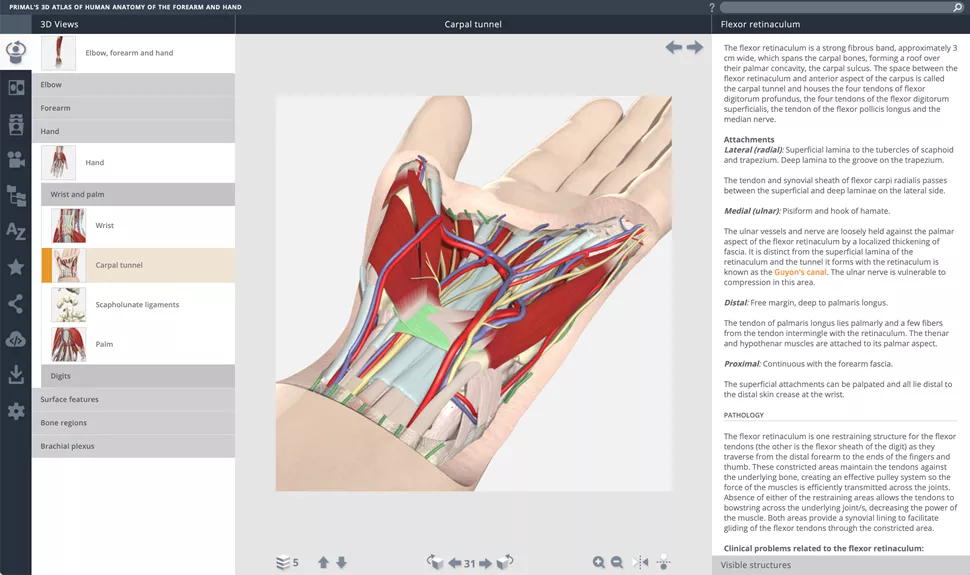
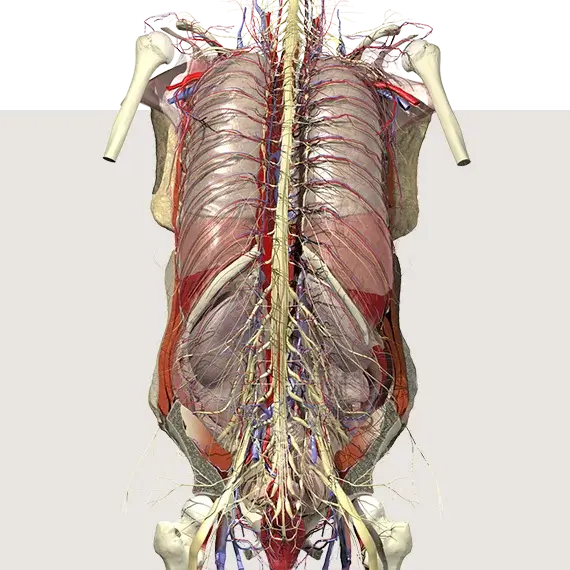
Rendering 3D models from the 2D scanned slices. The software used is the same one used by Pixar © to create 3D models for movies like Toy Story ©.


About Primal Pictures

Primal Pictures, Ltd., UK was established in 1991 by two experienced members of the computer graphics and television industries: Laurie Wiseman, an award-winning documentary filmmaker for Channel 4, PBS network and ITV; and Chris Briscoe, a global pioneer of 3D computer graphics and founder of Digital Pictures. Briscoe’s graphics have won major awards in the USA and Britain, including Monitor and Clio awards.

The core research group investigated techniques for creating high-resolution graphics for medical teaching. Working with academic institutions, including University College, London, the group was awarded grants from the European Community Media Program and a number of UK Government innovation funds to create 3D anatomy computer graphics.

The DVD-ROMs feature 3D computer graphic models of human anatomy, derived from medical scan data. 3D animations showing function, bio-mechanics, and surgical procedures supplement the core anatomy, accompanied by clinical videos and texts written by leading medical specialists around the world. The world's first complete 3D anatomical model of the entire body – a Gray’s Anatomy for the 21st Century. Future enhancements, such as animated structure movement and function, and a suite of specialized versions for a variety of medical disciplines are planned.

Special Thanks to:
Virginia Mason Hospital
George Cozzetto, MD


Home | Human Physiology | Software DVD-ROMs | Anatomy Pictures | About Us | Help
Sitemap | Privacy Policy | Copyright Info